Anders
A Man Called OveAnders is a neighbor of Ove’s, known for his Audi, his towing company, and a manner that Ove regards with amused disdain. Yet when Ove needs help, Anders’s professional resources prove more useful than appearances suggest. He becomes part of the network of neighbors who act together, and later shares in the neighborhood’s ordinary pleasures and work.
Identity and Introduction
Anders is introduced through Ove’s judgment of him as a fop from a neighboring house. That dismissive label establishes their comic difference in temperament, but does not fully define Anders: he has a company, knows how to deploy its equipment, and is willing to join an improvised plan when a neighbor asks for help. His presence belongs to a residential area changing around him. More houses are built, and a once-quiet outlying place becomes a city district, with residents increasingly relying on one another’s practical knowledge.
His car and his work are linked in the narrative. Anders drives an Audi, but the more consequential fact is that his company can tow vehicles. The revelation comes when Ove’s conflict with The man in the white shirt over a white Škoda reaches a stalemate. The distinction matters: Anders’s contribution is not simply agreement with Ove, but access to a specific capability that can alter the situation.
The Škoda and Ove’s Plan
After a phone call makes clear that the investigation into Ove’s case has lasted two years and that nothing can be done through the usual channels, Ove demands a new plan. Patrick goes out and returns with Anders and Jimmy. Ove initially objects to Anders’s presence, but Patrick’s response makes clear that he has brought Anders precisely because Ove needs a plan.
Anders approaches the matter cautiously, first asking about Ove’s problem with the Škoda and then explaining what kind of company he runs. He gives Patrick a nervous glance before disclosing the business, while Ove listens and becomes more receptive. The account presents the proposal as unexpectedly opportune: the company can remove the car that has been kept in defiance of the residential-area vehicle restriction.
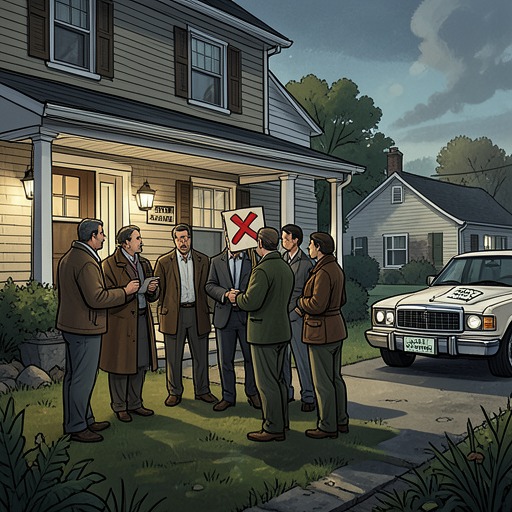
When The man in the white shirt arrives with a police officer to demand the car’s release, both the Škoda and the trailer are already gone. Anders’s tow truck has taken the car to a gravel pit twenty-five miles outside town. Ove stands calmly outside his house and lets his adversary believe he knows nothing about the disappearance. He points instead to the posted prohibition on cars in the area. Asked by the police officer whether he really saw nothing, Ove claims that his memory may be failing. The scene turns Anders’s practical assistance into a quiet piece of collective resistance: the neighbors exploit their own resources while leaving Ove to maintain a deliberately unhelpful silence.
Personal Relationships and Neighborhood Life
Anders’s life is not limited to his dealings with Ove. At one point, he explains that he and a woman have split up and that she has moved out. The account connects the breakup to her irritation with Ove’s feuding with her and her dog, especially his habit of calling the dog Mutt and his inability to hide that he found the name amusing. Ove’s neighborhood quarrels therefore have consequences beyond the immediate arguments: they can strain the relationships of people living nearby.
Later, Lena moves in with Anders. The narrative does not explain the change in their relationship, but places them together in a later phase of neighborhood life. Ove drives their moving van because he does not trust them to back it between the houses without damaging his new mailbox. His grumbling does not prevent him from helping; indeed, his concern for the mailbox is the reason he takes the wheel himself. The episode makes Anders part of the same pattern of practical neighborly involvement that shapes Ove’s connection to the street.
A young neighbor also announces plans to go skating on the lake with Anders. The brief exchange gives him a place in the area’s informal social life, beyond the towing-company episode and his relationship with Lena. It does not specify the nature of the connection, but shows Anders as someone included in a neighbor’s plans for an ordinary outing.
Public Role and Significance
Anders is elected again as chairman of the Residents’ Association, indicating that his involvement in the neighborhood is institutional as well as personal. The repeated election places him among the residents who help manage local affairs as the district grows. His role contrasts with Ove’s more confrontational approach to rules: Ove insists on the vehicle prohibition, while Anders helps solve a dispute through the resources of his business and participates in the association’s ongoing life.
The narrative also gives Anders a useful place in its portrait of community. Ove may initially see only a foolishly dressed neighbor, but the crisis over the Škoda exposes a capable ally; later scenes show Anders moving, skating, and serving as association chair. These episodes do not turn him into a central confidant of Ove. Instead, they establish how a neighborhood can depend on people whose value becomes visible in particular circumstances—and how Ove’s scornful judgments coexist with his willingness to accept, and sometimes provide, practical help.